Indoor Air Quality Testing
Occupant exposure risk is not always visible. Indoor air quality testing applies real measurement and building science reasoning to what a room's air is actually carrying, from airborne particulates to spore concentrations to the ventilation performance behind them.
Analysis of the air occupants actually breathe
Indoor air quality testing is one of the interconnected disciplines within our building science work: analysis of airborne particulates, spore concentrations, ventilation performance, and occupant exposure risk.
Airborne Particulates & Spore Concentrations
Air sampling equipment is set up directly in the spaces people occupy, capturing what is actually suspended in the air rather than relying on a visual walkthrough alone. This is how we document airborne particulates and spore concentrations as part of a broader indoor environmental investigation.
Ventilation Performance
How air moves, or fails to move, through a space affects how particulates and spores accumulate. Evaluating ventilation performance is part of understanding the exposure conditions inside a structure, not a separate concern from the air itself.
Humidity & the Dew Point Relationship
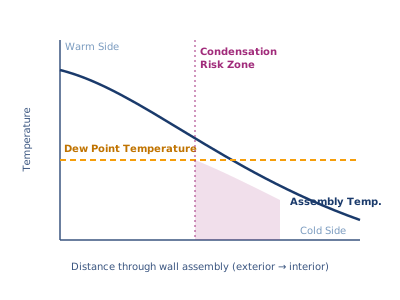
Condensation risk is driven by where a wall assembly's temperature gradient crosses the dew point, creating condensation risk, not by a humidity percentage in isolation. Understanding this relationship is central to explaining why some spaces develop moisture and microbial issues while others with similar humidity readings do not.
Occupant Exposure Risk
Ultimately, indoor air quality testing exists to characterize occupant exposure risk: what people in a given space are actually being exposed to, based on measured conditions rather than assumptions.
Occupant health depends on what you can't see
Air quality problems rarely announce themselves the way a visible leak or a musty smell does. Testing gives occupants and property owners an evidence-based understanding of exposure risk instead of a guess.
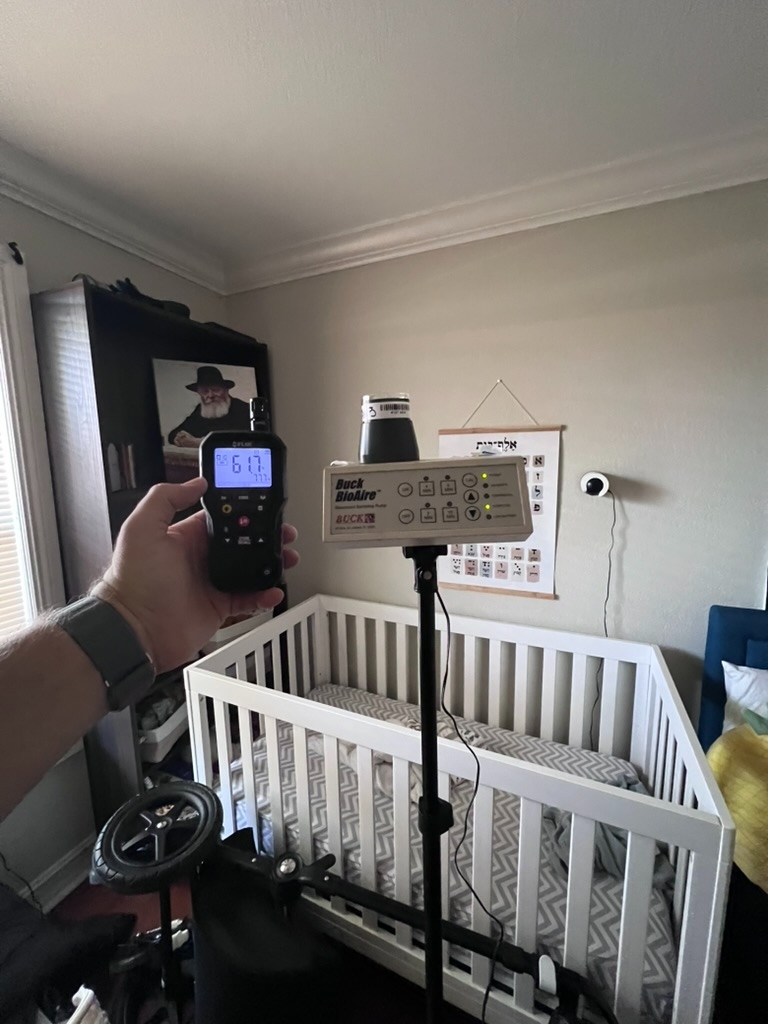
Bedrooms, nurseries, and other spaces where occupants spend extended, low-activity hours are a natural focus for indoor air quality assessment, since prolonged exposure in a single space compounds any air quality issue present.
Because occupant exposure risk depends on ventilation performance and particulate or spore concentrations working together, testing that only looks at one factor in isolation can miss the actual condition of a space. Our approach documents airborne particulates, spore concentrations, and ventilation performance together, so the resulting picture reflects what occupants are truly exposed to.
The science behind dew point and thermal anomalies
Original diagrams we use internally to explain how moisture, air, and heat actually move through a structure, and why they matter to indoor air quality.
Dew Point
How a wall assembly's temperature gradient crosses the dew point, creating condensation risk.
Thermal Anomalies
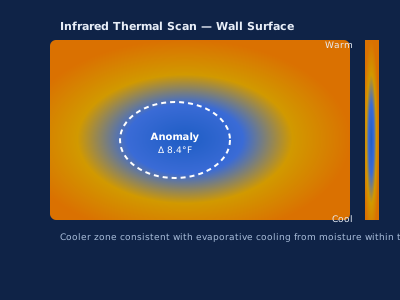
How a hidden moisture source appears as a distinct temperature anomaly under infrared.
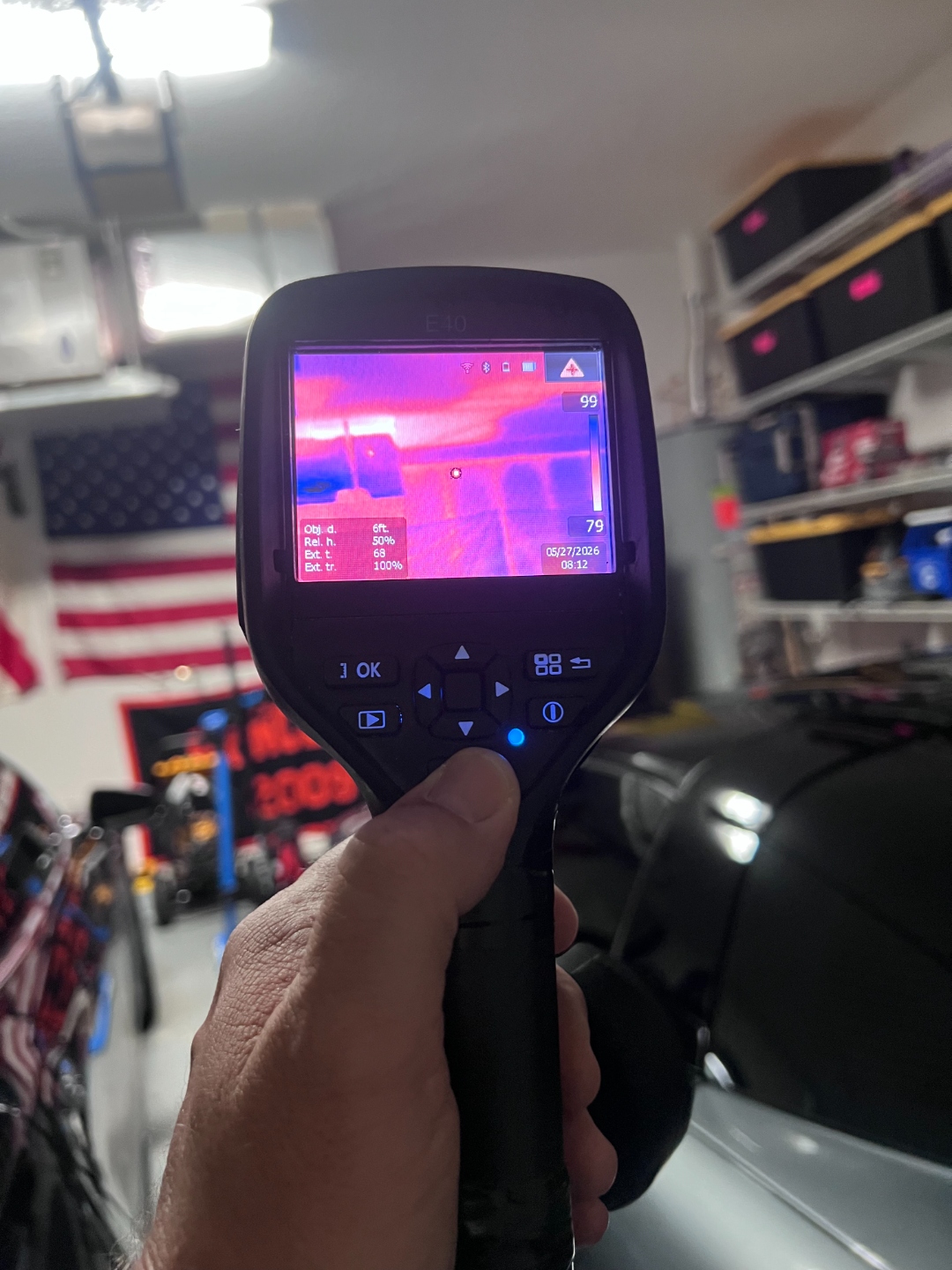
Infrared Documentation
Thermal imaging in the field, used to locate the temperature anomalies that indicate hidden moisture affecting air quality.
A companion to mold inspection, not a replacement
Indoor air quality testing and mold inspection address related but distinct questions, and combining them gives a more complete picture than either does alone.
Mold Inspection
Systematic identification and documentation of fungal growth, its extent, and its underlying moisture source. This work is visual and investigative, tracing a problem back to where it started.
Learn about Mold Inspection →Indoor Air Quality Testing
Analysis of airborne particulates, spore concentrations, ventilation performance, and occupant exposure risk. This work is measurement-based, characterizing what is actually present in the air people breathe.
Learn about Mold Testing →Because condensation risk depends on where a wall assembly's temperature gradient crosses the dew point, air quality findings often point back toward a mechanical or building envelope issue. That is why indoor air quality testing is frequently paired with an HVAC mold inspection or a broader moisture and water intrusion investigation, so a single air quality reading is understood in the context of its underlying source rather than treated as an isolated number.
Equipment and evidence, as we actually use them
A closer look at the equipment and conditions we document during a real indoor air quality assessment.
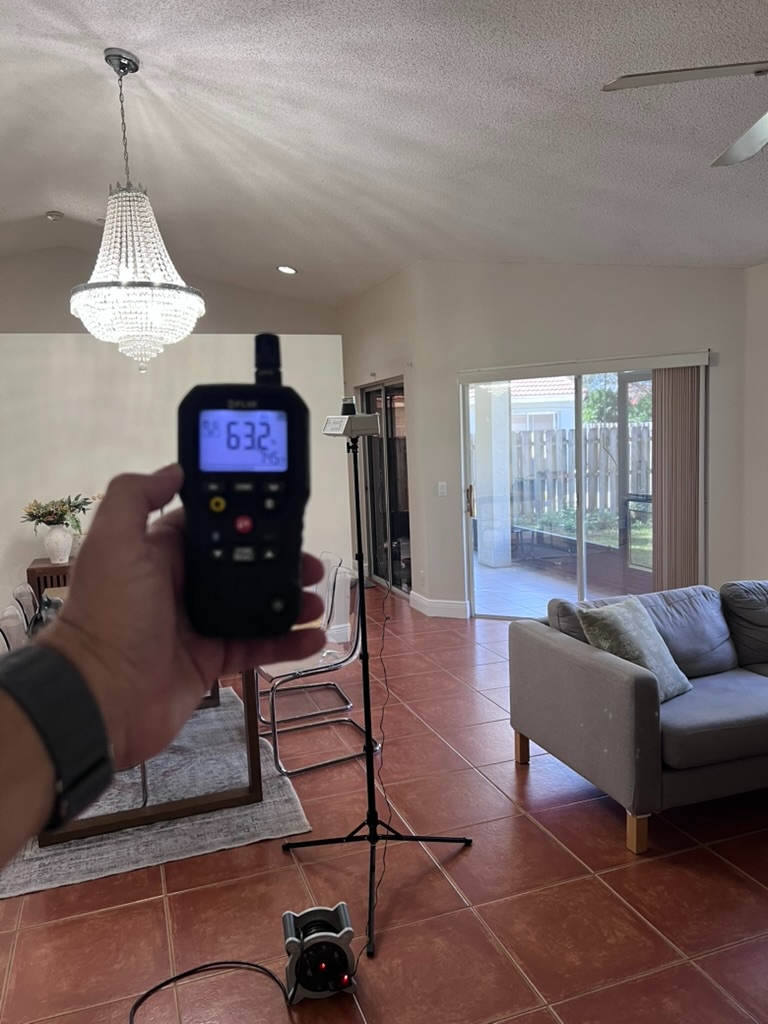
Indoor Air Quality Setup
Air sampling equipment positioned in an occupied living space to capture representative airborne conditions.
Bedroom Air Assessment
A sampling pump positioned near a crib to evaluate air quality in a space with extended occupant exposure.
Thermal Imaging
Infrared documentation used alongside air sampling to connect air quality findings to their underlying cause.
Common questions about indoor air quality testing
Indoor air quality testing analyzes airborne particulates, spore concentrations, and ventilation performance, giving a picture of occupant exposure risk that a visual walkthrough alone cannot provide.
Mold testing focuses specifically on identifying fungal species and spore concentrations through air and surface sampling processed by an independent laboratory. Indoor air quality testing looks more broadly at airborne particulates, ventilation performance, and occupant exposure risk, of which mold spores are one component.
Condensation risk is driven by where a wall assembly's temperature gradient crosses the dew point, not by humidity readings in isolation. A space can have moderate humidity and still develop condensation risk if surface temperatures fall below the dew point.
Our team sets up air sampling equipment in occupied living spaces and bedrooms to evaluate airborne particulates and spore concentrations, often paired with infrared thermal imaging to identify temperature anomalies linked to hidden moisture.
Fields of knowledge that connect to air quality
Indoor air quality testing is rarely the whole story on its own. These related disciplines help trace an air quality finding back to its source.
Mold Testing
Air and surface sampling processed by independent, accredited laboratories to identify species and concentrations.
HVAC Mold Inspections
Inspection of air handlers, ductwork, and coils for microbial growth, condensation defects, and airflow issues.
Moisture & Water Intrusion
Tracing water intrusion, condensation, and vapor drive back to a building's structural and mechanical root cause.
Book an independent air quality assessment
Same-day service available throughout Miami-Dade, Broward, and Palm Beach Counties.